MMXXVI
Methodology & Evaluation Framework
Investigative Journalism Excellence Award
1. Purpose of the Award
The Investigative Journalism Excellence Award, conferred on both an individual and a media organisation, recognises outstanding investigative reporting that has exposed wrongdoing, advanced transparency, and contributed meaningfully to public accountability in South Africa.
The award celebrates investigative journalism that:
-
Confronts abuses of power
-
Illuminates systemic corruption or institutional failures
-
Demonstrates rigorous, ethical and courageous reporting
-
Drives meaningful public-interest impact or reform
This category highlights the indispensable role of investigative journalism in strengthening constitutional democracy.
2. Definition of Investigative Journalism for the Purpose of This Award
Investigative journalism refers to systematic, evidence-driven reporting that uncovers information of public significance which powerful actors seek to conceal.
For this award, qualifying work must demonstrate:
-
Independent initiative by the journalist or newsroom
-
Multi-source verification, documentation, and analysis
-
Exposure of previously hidden wrongdoing or systemic issues
-
A clear public-interest imperative and contribution to accountability
Routine reporting, commentary, or opinion pieces do not qualify.
3. Eligibility Criteria
Submissions must:
-
Be published or broadcast within the eligibility period
-
Originate from South African journalists or investigative units, or relate substantively to South African public-interest issues
-
Demonstrate adherence to ethical journalism standards
-
Be verifiable through publicly accessible links or documentation
Collaborative investigations (cross-newsroom, cross-border, or multidisciplinary) are eligible. Freelancers are equally eligible.
Investigations produced by organisations serving on the judging committee or sponsoring this category are excluded to protect integrity.
4. Core Values Guiding Evaluation
The award is grounded in five core values:
1. Courage
Fearless pursuit of truth despite threats, intimidation, obstruction or institutional resistance.
2. Integrity
Commitment to accuracy, fairness, ethical sourcing, transparency of process, and minimisation of harm.
3. Public Interest
The investigation must serve the collective good, protect the vulnerable, or expose significant wrongdoing affecting society.
4. Accountability
The investigation must advance democratic oversight by prompting scrutiny, reform, justice, or public awareness.
5. Excellence & Rigour
Depth of investigation, analytical strength, clarity of narrative, and sophistication of research methods.
5.1 Evaluation Criteria and Weighting (Individual)
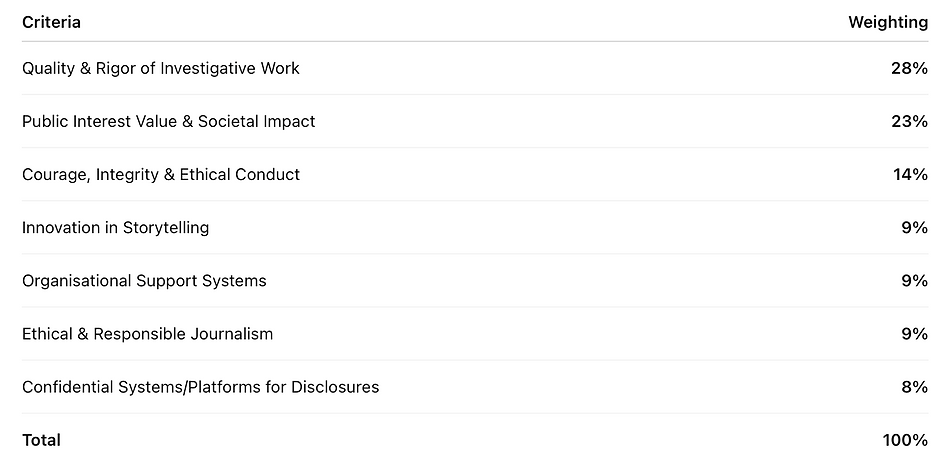
Submissions are evaluated against six weighted criteria, totalling 100 points:

5.2 Evaluation Criteria and Weighting (Media Organisation)
Submissions are evaluated against six weighted criteria, totalling 100 points:
1. Quality and Rigor of Investigative Work — 28%
Assesses the organisation’s commitment to depth, methodological discipline, and factual precision.
Indicators:
-
Evidentiary strength and source corroboration
-
Depth of research and analytical sophistication
-
Rigorous verification processes
-
Accuracy and factual integrity of published work
2. Public Interest Value and Societal Impact — 23%
Evaluates how the investigative work advances democratic accountability and serves the public interest.
Indicators:
-
Relevance to corruption, abuse of power, systemic wrongdoing, or public harm
-
Tangible impact (policy reforms, prosecutions, institutional change)
-
Public engagement, resonance, and community relevance
-
Contribution to transparency and accountability
3. Courage, Integrity, and Ethical Conduct — 14%
Recognises principled journalism in the face of risk or external pressure.
Indicators:
-
Pursuit of sensitive or high-risk investigations
-
Protection and ethical handling of sources and whistleblowers
-
Editorial independence from political or commercial influence
-
Evidence of integrity in investigative and editorial decisions
4. Innovation in Investigative Storytelling — 9%
Rewards creativity in how investigations are produced and delivered.
Indicators:
-
Effective and novel use of multimedia or digital tools
-
Data-driven storytelling and visualisation
-
Innovative formats that enhance accessibility or audience reach
-
Cross-platform or collaborative investigative models
5. Organisational Support for Investigative Journalism — 9%
Assesses the institutional environment that enables sustained investigative capacity.
Indicators:
-
Dedicated investigative desks, budgets, and expertise
-
Internal fact-checking, editorial oversight, and legal review
-
Capacity-building, mentoring, and training
-
Clear internal policies for source protection and ethical conduct
6. Ethical and Responsible Journalism Practices — 9%
Evaluates the organisation’s alignment with global journalism ethics.
Indicators:
-
Fair, accurate, and balanced reporting
-
Responsible handling of vulnerable individuals and communities
-
Transparency in methods and correction of errors
-
Clear separation between editorial and commercial interests
7. Confidential Systems/Platforms for Making Disclosures — 8%
Assesses the organisation’s capacity to receive, secure, and ethically manage sensitive information from whistleblowers and confidential sources.
Indicators:
-
Existence of secure, encrypted platforms for anonymous disclosures
-
Policies governing access control and data protection
-
Evidence of safeguarding source identities and information integrity
-
Processes for verifying and responsibly assessing confidential submissions
-
Alignment with global best practices for digital security and source protection
5.3 Summary of Weighting Table
6. Evaluation Process
Stage 1: Eligibility and Completeness Review
-
Verification that the submission meets all eligibility requirements
-
Confirmation that links, documents and supporting materials are functional and complete
-
Initial check for ethical or procedural concerns
Stage 2: Independent Scoring
-
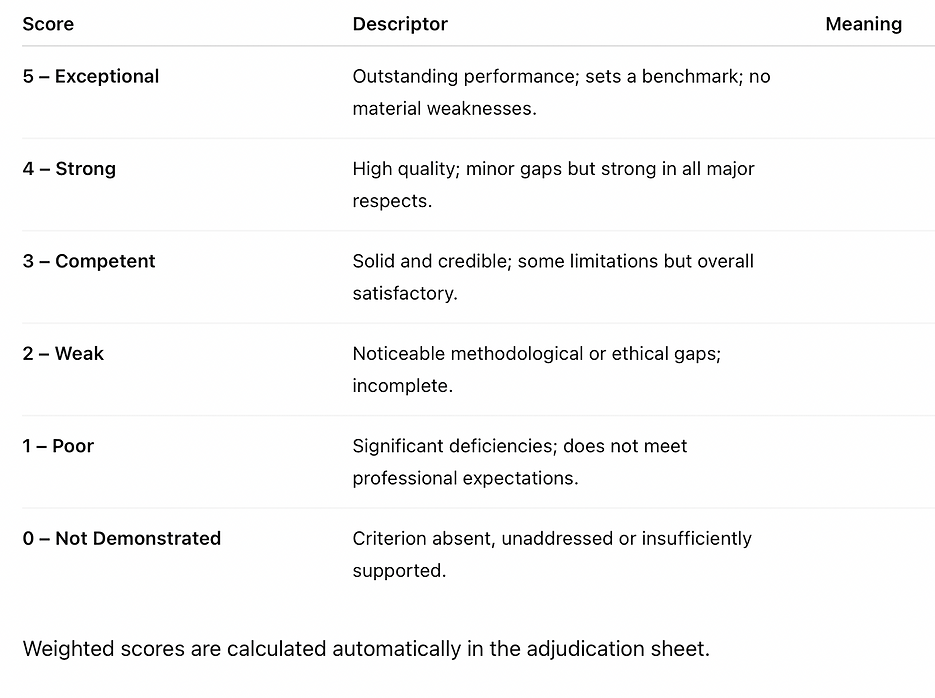
Each judge independently scores the submission against the six evaluation criteria using the 0–5 scale and weighting rubric.
Stage 3: Consolidation and Ranking
-
Scores are aggregated, ranked, and a shortlist is compiled.
Stage 4: Final Deliberation
The judging panel discusses:
-
Contextual complexities
-
Additional social, historical or political relevance
-
Accuracy and ethical considerations
-
Real-world constraints under which the investigation emerged
-
Discrepancies in scoring
Where necessary, clarifications may be requested from the nominator or editorial representative.
Stage 5: Decision and Citation
The winner is determined by consensus; failing consensus, a majority vote is used.
The panel produces a formal citation capturing:
-
The nature of the investigation
-
Its primary findings
-
Its public-interest significance
-
Its impact
-
Why it represents excellence in investigative journalism
7. Scoring Methodology (0–5 Scale)
8. Conflict-of-Interest Management
To maintain integrity and impartiality:
-
Judges must disclose any real or perceived conflicts with submitters or media houses.
-
A conflicted judge must recuse themselves from the evaluation of that entry.
-
Judges may not evaluate investigations their organisation published.
-
Entries from award sponsors are ineligible in this category.
Conflicts are recorded in the official adjudication record.
9. Transparency Principles
Public Interest SA commits to transparency through:
-
Publishing this methodology and criteria on the Awards website
-
Making the selection framework available to nominees
-
Providing high-level feedback to finalists upon request
-
Documenting adjudication procedures for audit and accountability
This ensures legitimacy, fairness, and credibility.
10. Alignment with Global Standards
This framework draws from internationally recognised investigative journalism benchmarks, including:
-
Global Investigative Journalism Network (GIJN)
-
Investigative Reporters & Editors (IRE)
-
International Consortium of Investigative Journalists (ICIJ) standards
-
Press Council Code of Ethics
-
UNESCO and AU frameworks on media freedom and safety of journalists
It aligns local practice with global best practice while remaining context-sensitive to South Africa’s accountability landscape.
11. Purpose and Expected Impact
By recognising excellence in investigative journalism, the Award:
-
Elevates high-quality public-interest reporting
-
Protects the constitutional role of the press
-
Encourages newsrooms to invest in investigative capacity
-
Strengthens relationships between whistleblowers and journalists
-
Inspires emerging investigative reporters
-
Promotes a culture of transparency and accountability
It forms a central pillar of the Whistleblowers Awards ecosystem.
Our Partners.
We extend our deepest gratitude to our esteemed partners for their unwavering generosity and steadfast support of the Whistleblowers Awards & Summit initiative. Their commitment to our cause is the driving force behind this event's success. Their contributions not only help us honour the brave individuals who have championed ethical values but also advance the vital conversation around accountability and justice. Together, we are making a meaningful difference in the world, and we are profoundly thankful for their partnership in this noble endeavour. Their support truly embodies the spirit of ethical citizenship and positive change.